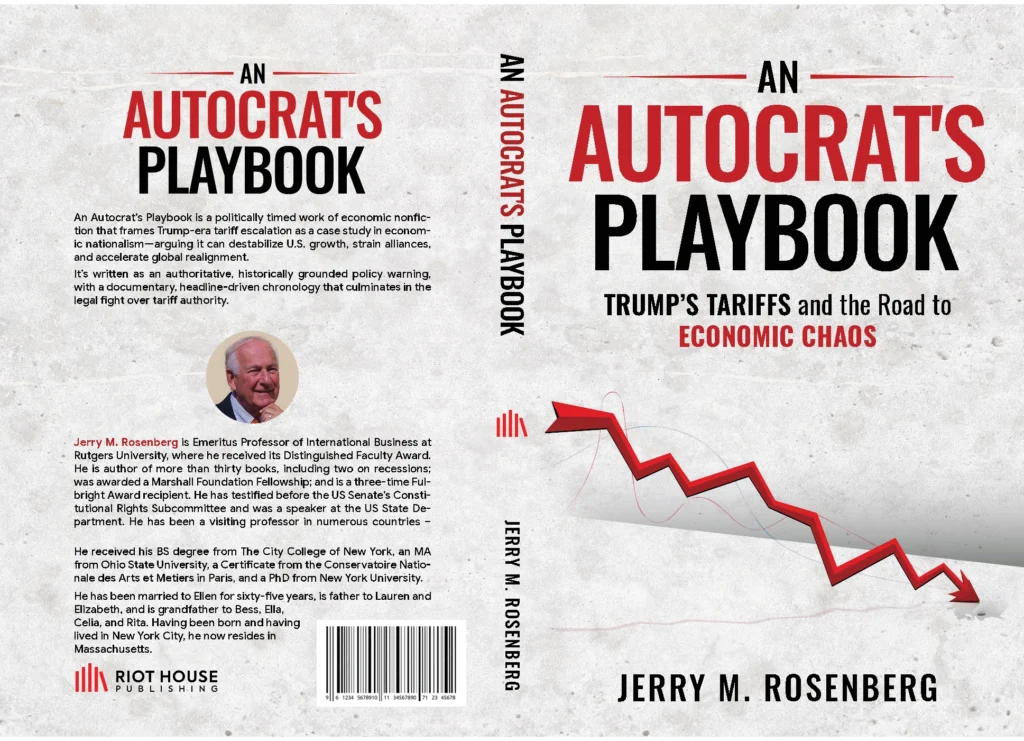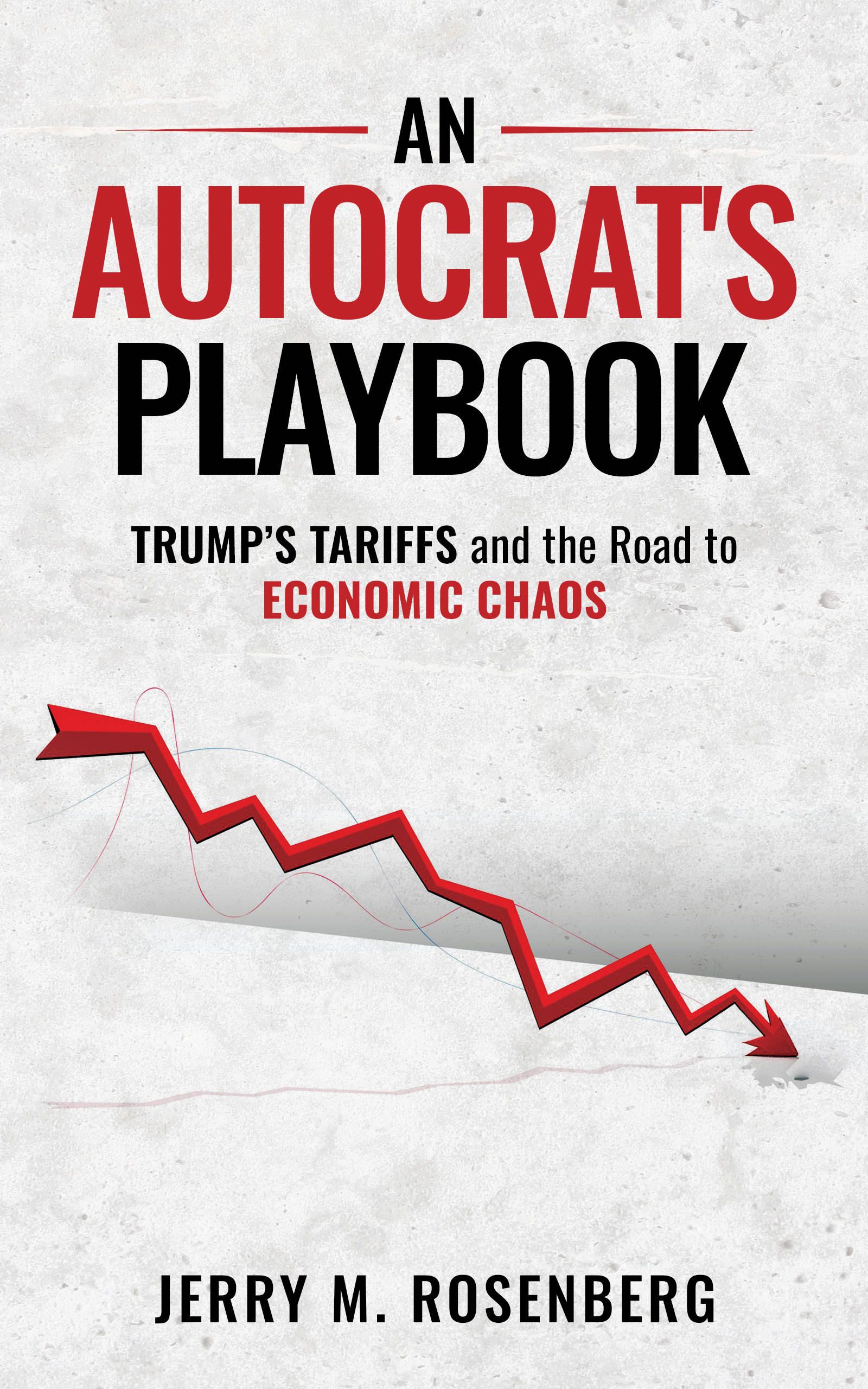
AN AUTOCRAT’S PLAYBOOK
Trump’s Tariffs and the Road to Economic Chaos
Jerry M. Rosenberg
A century of recession history meets the trade war of today — from a scholar who has chronicled every major economic crisis for more than sixty years.
Order Now [ Amazon ] [ Bookshop.org ] [ Barnes & Noble ]
Released August 25, 2026 · Trade paperback · [ISBN 979-8-9964976-0-7]
“Whatever else defines this term, tariffs are the administration’s central economic weapon — and the costs are already showing up in prices, markets, and alliances.”
An Autocrat’s Playbook frames the escalation of Trump-era tariffs as a case study in economic nationalism — and argues it risks destabilizing U.S. growth, straining alliances, and accelerating a global realignment already underway. Authoritative and historically grounded, it reads as a documentary chronology rather than a partisan polemic, tracing the policy from its announcement to the legal battle over who holds the power to tax the world’s imports.
Tariffs are back at the center of American economic life — and with them, questions the country has faced before. Do trade barriers protect workers or punish consumers? Do they strengthen a nation’s hand or isolate it? And who, under the Constitution, actually holds the authority to impose them?
In An Autocrat’s Playbook, economist and historian Jerry M. Rosenberg situates today’s trade wars within a full century of economic history — from the Smoot-Hawley Tariff Act of 1930, through the Great Recession, through the COVID-19 shock, to the present. Drawing on six decades of chronicling how economies rise, stall, and unravel, Rosenberg documents how protectionist policy has repeatedly promised prosperity and delivered strain, and why the current moment carries distinct risks for prices, markets, and America’s alliances.
This is not a book of personalities or insider gossip. It is an analysis of consequences: how tariff-driven economic nationalism reshapes global trade, tests constitutional limits on executive power, and reorders the balance of economic leadership among nations. Rigorous, cautionary, and readable, it is written for anyone trying to understand not just what is happening to the economy, but what history tells us about where it may lead.